

Sound insulation for your boat's engine room
Do you want to improve the sound insulation of your boat's engine room? Then it is important to first determine which type of engine noise you hear. In a boat or yacht, noise usually arises in two ways: as airborne noise from the engine room and as impact noise through vibrations in the hull.
Because these noise problems have a different cause, the solution also calls for a different approach. A combination of sound absorption, adding mass and vibration damping often works best.
Boat engine room sound insulation: first determine the type of noise
In many boats and yachts the engine is the main source of noise nuisance. The noise can be audible in the cockpit, saloon, sleeping cabins and sometimes even far outside the machine room. Good engine room insulation therefore does not start with simply sticking material on, but with identifying the cause.
Airborne noise in the engine room
How do you recognise it? The engine noise is loudest close to the engine room and reflects off hard surfaces.
Best approach: fit sound-absorbing material on walls, hatches and ceiling.
Noise to cabins or saloon
How do you recognise it? Engine noise penetrates adjacent spaces, such as cabins, saloon or wheelhouse.
Best approach: add weight to light walls, floors or hatches with mass-loaded sheet.
Vibrations in hull or panels
How do you recognise it? The hull, hatches or panels vibrate along and act as a sounding board.
Best approach: check the engine mounts and damp the hull around the noise source.
Two types of engine noise: airborne noise and impact noise
Airborne noise is the sound that the engine produces directly and that spreads through the air. In a hard, untreated machine room this noise bounces off walls, hatches and the ceiling. As a result the noise level in the engine room and beyond can increase.
Impact noise arises because the engine passes vibrations on to the structure of the boat. The hull, sheet metal or wooden panels can then radiate these vibrations as sound. As a result, engine noise can sometimes be just as audible in a forward cabin as in the machine room itself.
For effective boat sound insulation it is therefore important to assess airborne noise and impact noise separately.
Which approach suits your engine room?
Sound absorption against airborne noise
You reduce airborne noise by fitting sound-absorbing material in the engine room. Preferably place this material as close as possible to the noise source, so on the walls, hatches and ceiling around the engine.
A hard-finished machine room lets sound reflect easily. By lining large surfaces with absorbing material, these reflections are reduced. The larger the treated surface and the thicker the material, the better the result generally is, especially with lower engine tones.
When choosing material for the engine room, always pay attention to the conditions on board. The space can become warm, damp and contaminated by oil, grease or fuel vapours. So choose material that is suitable for use in a machine room and always check the product specifications.
Adding mass against noise to other rooms
Do you want to prevent engine noise from penetrating adjacent cabins, the saloon or other compartments? Then absorption alone is often not enough. In that case the construction needs more mass.
You do this by adding weight to light walls, floors or hatches with a mass-loaded sheet. Mass helps to stop sound transmission. A weighted hatch does work less well when gaps remain around the hatch. So where necessary, combine mass-loaded sheet with good gap sealing.
Vibration damping against vibrations in the hull
You tackle impact noise at the source: the vibrations themselves. First check whether the engine is on suitable vibration-damping mounts. Equipment such as a generator should also be placed on a sturdy and sufficiently heavy foundation, not on a thin bracket, tank or light panel that can easily vibrate along.
You can reduce the remaining impact noise by damping the hull around the engine. Vibration damping material such as sound deadening sheets stiffens the sheet metal, so it is less likely to act as a sounding board. In any case treat the parts where vibrations arise or are clearly noticeable.
For the best result you combine vibration damping with absorption in the engine room. Vibration damping reduces the vibrating along of the structure, while absorption limits the airborne noise bouncing around.
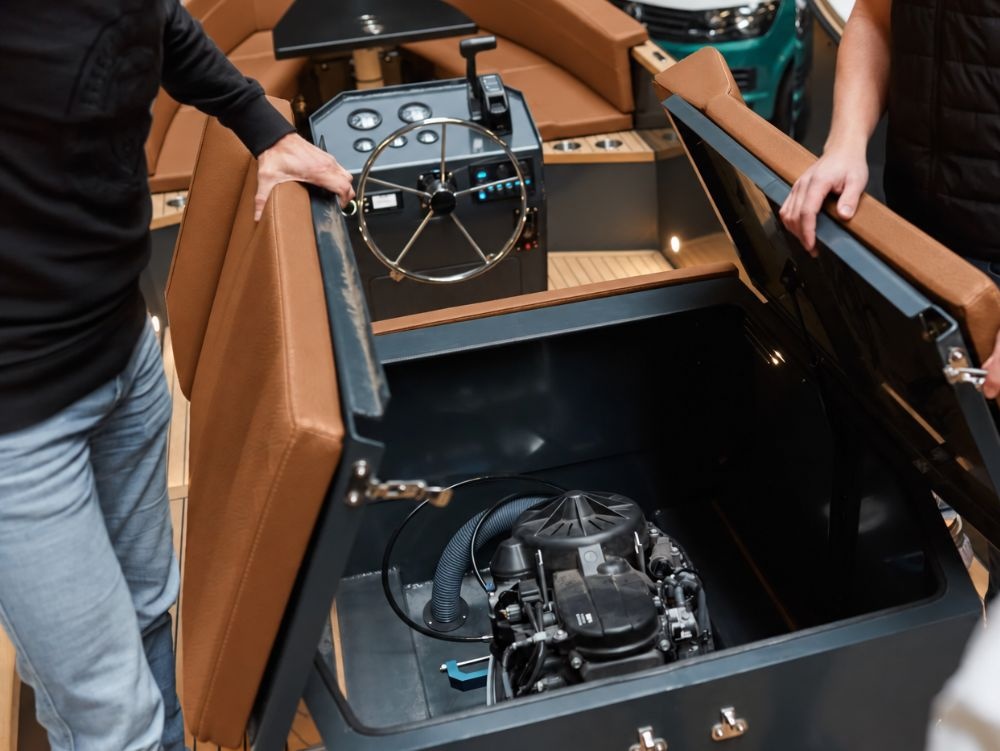
Step-by-step plan: insulating engine noise in your boat
With the step-by-step plan below you determine which form of boat engine room insulation suits your situation best.
- Check for sound leaks: look at hatches, seams, cable entries and connections.
- Determine the noise problem: is it mainly airborne noise, impact noise or sound transmission to other rooms?
- Tackle airborne noise: fit absorbing material on large surfaces in the engine room.
- Limit transmission: add weight to light walls, hatches or floors with a mass-loaded sheet.
- Check vibrations: look at the engine mounts and the foundation of the engine or generator.
- Damp the hull: fit vibration damping material on panel sections that vibrate along.
- Finish neatly: make sure the substrate is clean, dry and grease-free.
- Check again: test whether hatches close properly and no new gaps have appeared.
Which material do you need for engine insulation on a boat?
For engine insulation in a boat, a combination of materials is usually used. Which material you need depends on the noise problem and the build-up of the engine room.
Absorbing sheets
Application: suitable for reducing reflections and airborne noise in the engine room.
Mass-loaded sheets
Application: suitable for making light panels, floors or hatches heavier and limiting sound transmission.
Vibration damping material
Application: suitable for reducing vibrations in the hull, sheet metal or panels.
Sealing
Application: important for hatches, seams and entries where sound can escape.
Unsure which material suits your boat, engine room or noise problem? Then it is wise to first gather photos, dimensions and a short description of the noise. This makes it possible to determine more precisely which combination of absorption, insulation and vibration damping is needed.
Buy boat sound insulation from Geluidsisolatie Deal
At Geluidsisolatie Deal you will find materials for boat sound insulation, including absorbing sheets, mass-loaded sheets and vibration damping material. These solutions are used to control engine noise in and around the engine room better.
Because every boat is built differently, there is no single standard solution for every engine room. The right choice depends on, among other things, the type of engine, the available space, the material of the hull, the presence of hatches and the way sound spreads through the boat.
Not sure whether your situation calls for absorption, mass, vibration damping or a combination of these? Get in touch with us. Preferably send photos of the engine room and indicate where the noise is most annoying.

Frequently asked questions about sound insulation in a boat's engine room
What is the difference between airborne noise and impact noise from a boat engine?
Airborne noise is the sound that the engine produces directly and that travels through the air. Impact noise arises because the engine passes vibrations on to the hull, after which panels, floors or sheet metal can act as a sounding board.
Which sound insulation do I need for my boat's engine room?
That depends on the noise problem. Use absorption material against airborne noise, mass-loaded sheet against sound transmission to other rooms and vibration damping material against vibrations in the hull or panels. In many engine rooms a combination is needed.
How do I check whether my engine room has sound leaks?
In the dark, place a lamp in the machine room and close the hatch. Where light is visible, sound can escape too. Check hatch edges, entries, seams and connections in particular.
How much material do I need to insulate engine noise?
As a rule of thumb: the larger the treated surface and the thicker or heavier the material, the better the result usually is. Measure the walls, hatches and ceiling of the engine room and take account of cut-outs, ventilation and accessibility for maintenance.
Can I insulate my boat's engine room myself?
Yes, many materials are suitable for fitting yourself. Make sure the substrate is clean, dry and grease-free, finish edges neatly and check beforehand that the material is suitable for the conditions in the engine room.
May I close off ventilation openings in the engine room to stop noise?
No, necessary ventilation openings must not simply be closed off. The engine room must be able to remain safely ventilated. Preferably choose a solution that limits noise without blocking the required air supply or heat dissipation.