


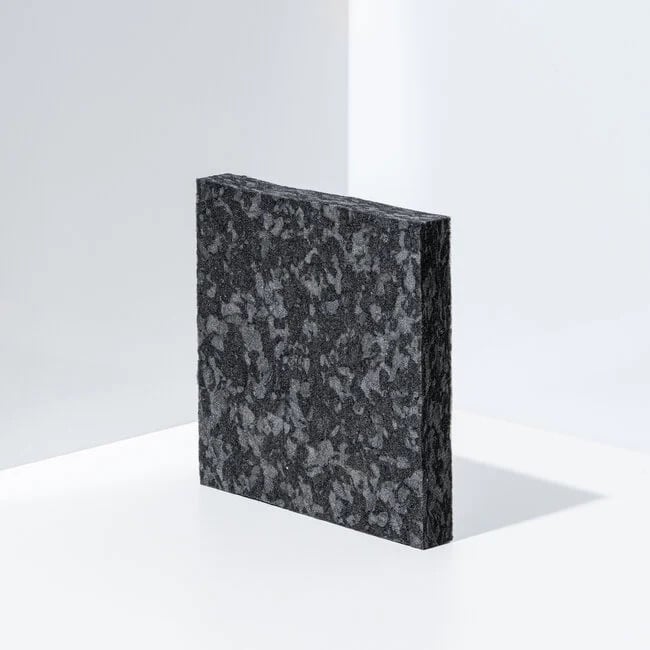
Impact noise insulation: the solution to annoying impact noise
Impact noise occurs when vibrations are transmitted directly to a floor, staircase, wall or other structure. Think of footsteps on an upper floor, scraping chairs, falling objects or the thumping sound of a staircase. Because this sound spreads through the structure, it can cause a lot of nuisance in adjacent rooms.
With good impact noise insulation you can reduce impact noise by dampening vibrations before they travel further through the building. The right solution depends on the situation. A concrete floor calls for a different approach than a wooden upper floor, a staircase or noise nuisance from neighbours.
What is impact noise and why is it so disturbing?
Impact noise is sound caused by direct contact with a building element. When someone walks, jumps, drops something or moves furniture, vibrations are created. These vibrations are passed on through the floor, staircase or wall to other rooms.
This makes impact noise different from airborne noise. Airborne noise spreads through the air, such as voices, music or television. Impact noise travels through solid materials. That is why an extra rug, ceiling board or foam layer alone is often not enough to solve the problem structurally.
How does impact noise insulation work?
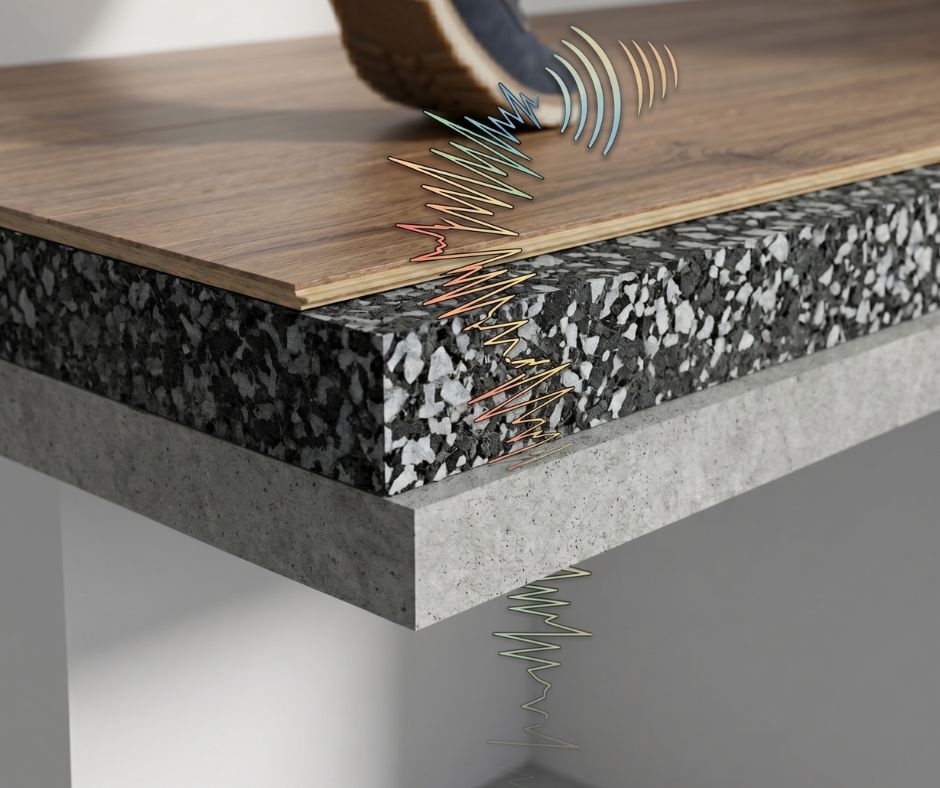
Reducing floor impact noise: what should you look out for?
If you want to reduce floor impact noise, correct installation is at least as important as the material itself. Impact noise can still be transmitted via rigid connections along walls, pipes, thresholds or skirting boards.
When choosing a solution, therefore pay close attention to the following points:
- Check whether it is a concrete floor or a wooden supporting floor.
- See how much build-up height is available.
- Match the insulation layer to the chosen floor finish.
- Avoid rigid connections along walls, pipes and thresholds.
- Use materials that are suitable for compressive loads and long-term use.
Reducing floor impact noise sounds simple, but in practice the complete floor build-up determines the end result. The wrong combination of materials can be less effective than expected.
Impact noise insulation for a wooden floor
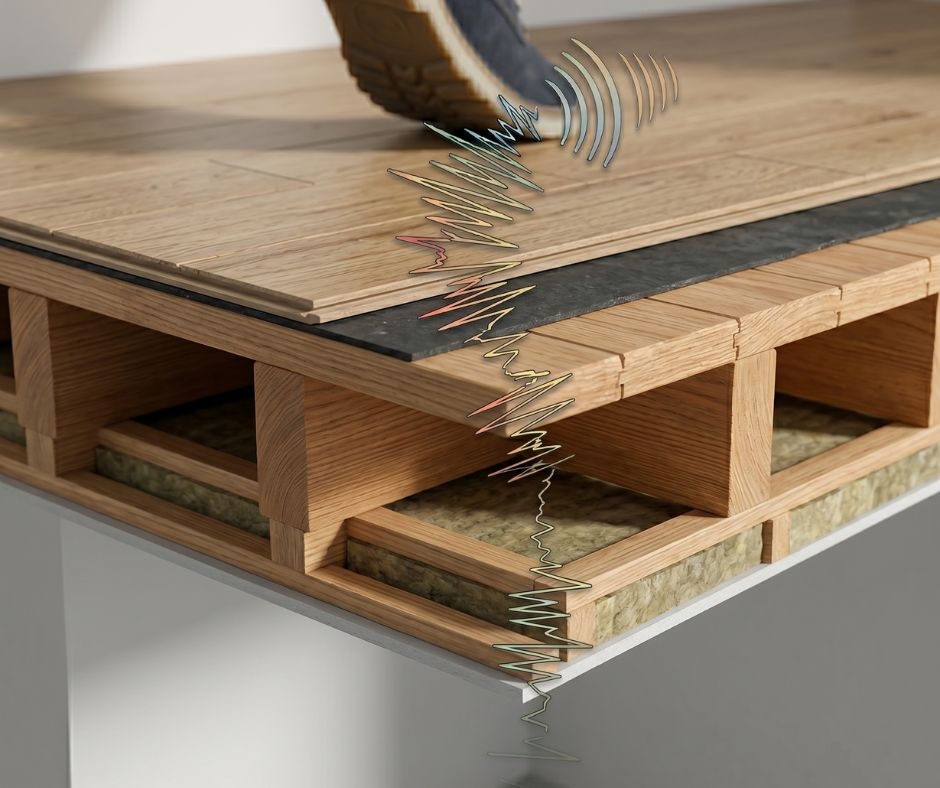
A wooden floor often transmits impact noise more easily than a heavy concrete floor. This is because wood is lighter and vibrates more readily. Footsteps, playing children or shifting furniture can therefore be clearly audible in the room below.
With a wooden upper floor it is important to look not only at the screed, but also at the supporting structure. A damping underlay, extra mass or a decoupled build-up can help to limit vibration. Which solution is suitable depends on the existing floor, the joists and the desired finish.
Practical case: impact noise via a wooden upper floor
Reducing impact noise from a staircase
Impact noise on a staircase is mainly caused by walking. Every step causes a vibration that can be passed on via the treads, stringer, wall fixings or floor structure. This sound is often experienced as thumping or booming.
Reducing staircase impact noise can be done in various ways. Think of damping covering on the treads, decoupling rigid contact points or adding sound insulation materials on or around the staircase structure. Especially with wooden staircases it is important to look out for gaps, hollow spaces and direct connections with walls or floors.
Common causes of impact noise on staircases
- Hard shoes on wooden or bare treads.
- A staircase that is directly connected to a wall or floor.
- Hollow spaces under or next to the staircase.
- Loose parts that cause extra resonance.
- Missing damping on the treads.
Impact noise from neighbours
Impact noise from neighbours is a common problem in apartments, upstairs flats and terraced houses. It is often footfall noise, shifting furniture, falling objects or stair noise that is transmitted via floors and walls.
The best approach depends on where the sound originates and which structure transmits it. Sometimes the solution lies in the floor of the upstairs neighbours, sometimes in insulation on the receiving side. Would you like to know more about this situation? Then read our extensive advice page on noise nuisance from neighbours.
Which solution suits your situation?
Not every impact noise requires the same solution. A floor, wooden floor or staircase each has a different structure and therefore calls for a suitable insulation build-up. Pay attention not only to the insulation material, but also to installation, connections and the risk of sound bridges.
Concrete floor
Common problem: footfall noise or shifting furniture
Possible approach: a damping underlayer or floating floor build-up can help to reduce impact noise.
Wooden floor
Common problem: vibration and resonance
Possible approach: combine mass, damping and decoupling to better limit impact noise via the floor.
Wooden upper floor
Common problem: footsteps audible in the room below
Possible approach: a PVC mass-loaded sheet can add extra mass. For extra effect, in some situations it can be combined with bonded foam.
Staircase
Common problem: thumping noise when walking
Possible approach: stair covering, damping or decoupling of contact points helps to reduce impact noise from the staircase.
Neighbours
Common problem: sound via floor, wall or ceiling
Possible approach: first analyse the source, structure and receiving room. Read more about noise nuisance from neighbours.
Why choose Geluidsisolatie Deal?

Frequently asked questions about impact noise insulation
What is impact noise insulation?
Impact noise insulation is insulation that dampens or interrupts vibrations before they are transmitted via a floor, staircase, wall or other structure. It is used to reduce sounds such as footsteps, shifting furniture, falling objects and thumping stairs.
How can I reduce impact noise?
Impact noise can be reduced by dampening vibrations, adding extra mass or decoupling structures. For floors this is often done with a suitable underlayer, PVC mass-loaded sheet, bonded foam or a floating floor build-up. The best solution depends on the floor structure and the source of the noise.
Which solution helps with impact noise via a wooden floor?
With a wooden floor, a combination of mass and damping is often needed. A PVC mass-loaded sheet can add extra mass to the floor build-up, so vibrations are less easily transmitted. In some situations it can be combined with bonded foam for extra damping and decoupling.
Does impact noise insulation help against noise from neighbours?
Impact noise insulation can help with noise from neighbours, but the right approach depends on the source and the structure. With upstairs neighbours, insulation at the source is often more effective than insulation on the receiving side alone. Read more on our advice page about noise nuisance from neighbours.
Can I reduce impact noise from a staircase?
Yes, impact noise from a staircase can often be reduced. Possible solutions are damping covering on the treads, tackling hollow spaces, fixing loose parts and reducing rigid connections with the floor or wall. Especially with wooden staircases it is important to limit resonance and direct contact points.