
Insulating wheel arches against tyre noise and road noise? Geluidsisolatie Deal explains which approach works for cars, vans and campers.
A large part of the driving noise in a car, commercial vehicle, van or camper does not come from the engine, but from the wheel arches. Tyre roll noise, splashing water, stones, gravel and vibrations from the road surface are passed straight on to the interior via the thin sheet metal of the wheel arch. By insulating the wheel arches, you reduce this sounding-board effect and make the vehicle calmer to drive.
Insulating wheel arches is particularly worthwhile when you hear a lot of tyre noise on motorways, brick roads, wet road surfaces or unmade roads. In cars you often notice this in the cabin or boot. In vans it sounds hollow more quickly in the load area. In campers, wheel arches often play a double role: they transmit driving noise and also have to be finished neatly in the interior.
On this page you can read when wheel arch sound insulation makes sense, which material you use and how you can insulate the wheel arches of a car, van or camper yourself.
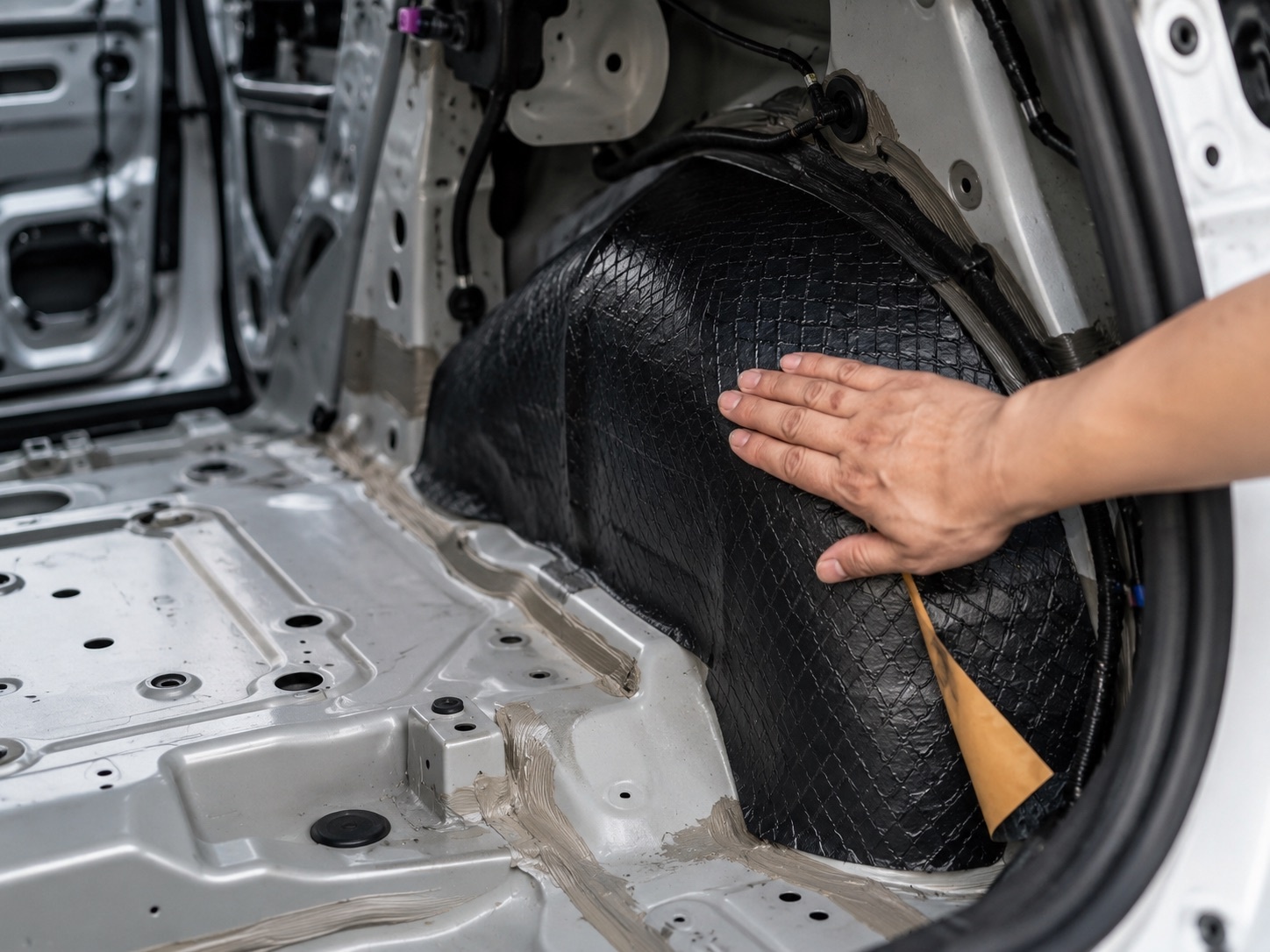
With wheel arch insulation it is mainly about reducing vibrations in the sheet metal. You do this with vibration damping material or damping mats with sufficient mass. You stick these to the inside of the wheel arch or to easily accessible metal parts around the wheel arch.
The aim is not to block every noise completely, but to slow down the vibrating along of the sheet metal. This reduces the hollow sound and passes on less driving noise to the cabin, load area or camper fit-out.
Problem: tyre roll noise is passed on to the interior via the wheel arches.
Best approach: sound deadening sheets on the sheet metal of the wheel arches and, where needed, additional floor insulation.
Problem: tapping, splashing and impact noise sound loud through thin sheet metal.
Best approach: damping material on easily accessible parts of the wheel arch and a neat finish where possible.
Problem: wheel arches in a van act as a sounding board in an empty or bare load area.
Best approach: combine wheel arch insulation with floor, wall and load area insulation.
Problem: bare wheel arches transmit driving noise and are often visible in the interior finish.
Best approach: first apply vibration damping, then finish neatly with, for example, covering or needle felt.
The reason for insulating wheel arches differs per vehicle. In a car it is usually about less tyre noise in the cabin. In a van the hollow load area is mainly the problem. In campers, comfort and finish also come into play alongside driving noise.
In a car, wheel arch insulation is usually about reducing tyre noise, stone chip noise and vibrations from the wheel arches or boot. Especially on motorways, brick roads and wet road surfaces this noise can be clearly audible in the cabin.
The practical approach is to insulate the wheel arches from the inside with vibration damping material. Where needed you combine this with damping of the boot floor or floor pan, because driving noise is often passed on via several metal parts at the same time.
In a commercial vehicle or van, the load area is often the biggest amplifier of noise. Bare wheel arches, large metal surfaces and an empty load area quickly produce a hollow sound. As a result you often hear tyre noise, stone chips and vibrations more strongly than in a passenger car.
So start by damping the wheel arches and combine this where needed with load area insulation, floor insulation and wall covering. In vans, needle felt is often chosen after insulating as wheel arch covering, so the wheel arches are also better protected against daily use.
In a camper, finish and living comfort also come into play alongside driving noise. Bare wheel arches can transmit a lot of noise on long journeys and are often visible in the interior or in storage spaces.
The best approach is usually to first damp the sheet metal of the wheel arches and then finish with covering, needle felt or a suitable interior finish. This way you combine less driving noise with a neat and durable finish of the camper interior.
Project cars and classics often have little factory insulation. Thin sheet metal, a bare boot and older floor finish can make tyre noise and mechanical driving noise more clearly audible.
So combine wheel arch insulation where needed with floor, boot and door insulation. This way you tackle not only the wheel arches, but also the other routes by which driving noise enters the interior.

Which solution suits best depends on the vehicle and the type of noise you want to reduce. Use the selection guide below as a starting point.
Suitable solution: self-adhesive sound deadening sheets on the wheel arches and optionally the boot floor
Why? The mass slows down vibrations of the sheet metal and reduces the sounding-board effect around the wheel arches.
Suitable solution: vibration damping on wheel arches, floor and large metal panels
Why? A bare load area amplifies noise quickly. By damping several panel sections, the space becomes less hollow and restless.
Suitable solution: damping material first, then needle felt or other covering
Why? This way you combine less driving noise with a neat finish of the camper interior.
Suitable solution: damping mats on easily accessible inner parts of the wheel arch
Why? Less vibrating sheet metal means fewer loud taps and less transmission of impact noise to the inside.
Besides sound insulation, people also often look for wheel arch covering and wheel arch protection. Especially in cars, commercial vehicles and vans, many people choose to cover the wheel arches neatly with needle felt after insulating. Needle felt provides a well-kept finish, helps reduce light reflections and secondary noises, and protects the underlying sheet metal and insulation material against daily use, sliding items or light knocks in the load area.
In vans, wheel arch covering is extra practical, because the wheel arches are often visible in the load area. By first fitting vibration damping material and then finishing with needle felt, you combine sound damping with protection and a neat look. In cars too, for example in the boot or with project cars, needle felt is often used to finish insulated wheel arches in a sleek and durable way.
You usually do not need to cover the wheel arch completely to notice an effect. With vibration damping, the point is to add sufficient mass to the parts that vibrate along. Treating a large part of the surface is often enough to clearly reduce the sounding-board effect.
Work mainly on the large, flat and easily accessible parts of the sheet metal. Press the material on firmly, especially on curved parts. Poorly pressed-on edges or air bubbles can cause the material to work less well or come loose over time.
A familiar situation is a van with an empty load area. While driving, a lot of tyre noise and stone chip noise can be heard, especially at the back. On inspection the wheel arches turn out to be bare and the sheet metal sounds hollow when you tap it.
In such a case a soft covering alone is often not enough. The best order is usually: first damp the wheel arches with self-adhesive damping mats, then include the floor and possibly the side panels, and only then finish with, for example, needle felt or load area covering. This way you tackle the vibrations first and then the finish.
Wheel arches are an important source of driving noise, but not the only one. For the best result you look at the total route by which noise enters the vehicle. In many vehicles that runs via wheel arches, floor, boot, load area and sometimes also via doors.
Mainly hearing engine noise from the front? Then look earlier at bonnet insulation or sound insulation of the engine bay. If you mainly hear driving noise from below or at the back, then wheel arches and floor are usually more logical.
Wheel arch insulation works best when the material adheres well and is fitted in the right place. In practice things often go wrong with the preparation or choice of material.

A wheel arch often consists of thin sheet metal right next to the rotating wheel. On contact with a rough road surface, stones or splashing water, this sheet metal starts to vibrate along and amplify noise. As a result the wheel arch acts as a sounding board.
Yes, you can usually insulate wheel arches yourself with self-adhesive damping mats or sound deadening sheets. Do make sure the sheet metal is clean, dry, grease-free and firm before you apply the material.
No, usually that is not necessary. With vibration damping, the point is to add sufficient mass to the parts that vibrate along. Treating a large part of the surface often already gives a clear effect.
For wheel arches you usually use self-adhesive sound deadening sheets or damping mats with sufficient mass. This slows down vibrations in the sheet metal. Needle felt or covering can then be used as a finish.
Yes, wheel arch insulation can help reduce tyre noise and driving noise, especially when the noise is transmitted via thin or bare sheet metal. For the best result you sometimes combine this with floor or boot insulation.
Yes, in vans the wheel arches are often clearly audible in the load area. Especially in bare or empty load areas they can amplify a lot of tyre noise and stone chip noise. Optionally combine wheel arch insulation with floor and load area insulation.
Yes, in campers the wheel arches are often first damped with vibration damping material and then finished neatly with covering or needle felt. This way you combine less driving noise with a well-kept interior finish.
Find the order you'd like to withdraw
Enter your email address and order number.
Check your mailbox
If your details match an order, you'll receive an email with a link to view and manage it.